Jerome Berryman’s Christology has fascinated me since I first began exploring the concept of Godly Play in 2004. In our conversations with Berryman, the German trainers spoke at length about the need for new stories in which people encountered Jesus of Nazareth. One result of this conversation was that we later wrote our own Jesus stories for the German-speaking context. Berryman’s own response was to write the volume of stories that was eventually published as volume 8 of The Complete Guide to Godly Play in 2012, but these stories did not resonate with many people in the German Godly Play community. I began to wonder: Why did we have such different approaches to stories about Jesus? The first clue was found in Berryman’s Episcopalian background, which in turn influenced Godly Play. As part of a 2024 qualitative study, I conducted initial research with Godly Play trainers from different denominational backgrounds. However, the only noticeable characteristics I found concerned the perception of Jesus’ presence in the Eucharist. This led me to reanalyze the texts of Berryman’s Jesus stories. In this article, I will summarize my analysis of what, in my view, is the particular Christology that takes shape in Berryman’s collection of stories.
Methodology
My research uses volumes 2, 3, 4, and 8 of the Godly Play story collection, which contain text material relating to Christology. However, since the texts from a story collection are not systematic theology reference texts, they require a mode of reflection specific to them:
-
I look at the design of the pedagogical texts from the perspective of the various genres of Godly Play, the introductions, and the texts that shape the direct presentation.
-
I analyze the design of the presentations, including the descriptions of gestures (with regard to the words, listeners, and space), illustrations, and the spatial arrangement in the Godly Play room.
-
In some instances, aspects about the design of the experience are also taken into account: the specific timing and positioning of a story within the spiral curriculum or in the school or church calendar, and its use and impact within a liturgical-ecclesiological context.
My intent is to consistently examine the text, presentation, and experience design through a christological lens.
Lastly, I have compared these story designs with three theological contexts:
-
Samuel Terrien’s The Elusive Presence. Written as a “prolegomenon to an ecumenical theology of the Bible,” this is a work to which Berryman repeatedly refers.[1] This book belongs to the tradition of interdenominational theology and proclamation in a secularly perceived world.
-
The incarnational theology of the Nicene Creed. Here the focus is on the understanding of statements regarding the incarnation of God.
-
Sallie McFague’s incarnational theology. Giving voice to a contemporary perspective, McFague understood God’s indwelling in the world in a transpersonal, cosmic dimension.[2]
Incarnational Christology in Berryman’s Work
To categorize the Christology in the Godly Play stories, a broad thematic arc can be drawn across two focal points. The first one is the special incarnational character of Berryman’s Christology. The second is his seamless transition from Christology to pneumatology, which is also grounded in the incarnation. This leads to an anticipated realization of Christ in the community of children, who themselves become co-creators of the new creation.
The arc spanning both focal points can be observed throughout Berryman’s entire body of work. In order to trace this particular form of incarnational Christology in concrete terms, I chose to focus on the stories “Faces of Easter,” “The Greatest Parable,” and “Knowing Jesus in a New Way.”[3] Important indications of Berryman’s incarnational concept can also be found in “Creation,” “The Holy Family,” and in the parables used in Godly Play.[4]
This Christological arc also affects the design of the materials used in the presentations. All stories with Christological themes in Godly Play use two-dimensional images. Cheryl Minor cites two important reasons for this:
-
The mystery of Christology in the Jesus stories is reflected in the material and is similar to the two-dimensional materials in the parable genre. The reason is “to point to something beyond what they are.” Minor continues: “When we encounter Jesus, we encounter not only a part of God, but all that God is (Father, Son, Holy Spirit).”[5]
-
The presentations about Jesus are arranged as a sequence of stories, making it possible to do justice to the whole of Christ’s story—his birth, life, death, and resurrection.
Both reasons confirm this arc. In the following, however, we will trace it through the peculiarities of selected stories.
“Faces of Easter”: The Influence of the Nicene Creed on Berryman’s Incarnational Christology
This series of seven short stories takes listeners on a journey through the life of Jesus from before his birth to his resurrection and ultimately to his presence today. “Faces of Easter” falls in the Godly Play spiral curriculum during the season of Lent. Berryman’s hermeneutical intention is clearly recognizable in the selected roles of Christ, especially in the events of salvation history recounted in these stories. In this series of stories, Jesus is portrayed as the God-Son who has come from God, is baptized, tested, and appointed, and who saves, tells parables, and gives the Last Supper to the Twelve and to us. He is also the one who died, was buried, rose again, and is present for us and among us. According to Cheryl Minor, Berryman wants to present a holistic Christ.[6] But especially with regard to the earthly Jesus, this is done in a highly selective manner, similar to the selections made by the early Christian creeds, especially the Nicene Creed. This creed sought to affirm a balance between the divine and human aspects of Jesus Christ and to avoid misrepresenting Jesus as leaning too far in either direction.
The Nicene Creed
Berryman’s writings suggest that his Christology was strongly influenced by the incarnation Christology conveyed in the Nicene Creed. It is the same creed that is recited every Sunday in Episcopal church services everywhere.[7] What exactly is this creed about? The debates preceding the Creed dealt with the question of Jesus Christ: What is his status between God and his creatures? The Arian opposition attributed an intermediate status to Jesus and argued that if Jesus were God, there would be two gods, which could not be the case. The “firstborn above all creation” must be the “first being” and have a special way of being. According to this opinion, Jesus would indeed be preexistent, but not existing before creation, and he would not possess eternal dominion. The other side stated that the intermediate status would make his connection to humanity clear, but not his connection to God. In the end, the First Council of Nicaea (325 CE) rejected Arianism and affirmed that the Son is “begotten, not made, of one substance with the Father,” a formulation that became part of the Nicene Creed. The wording in the Nicene Creed is as follows:
God from God, Light from Light, true God from true God, begotten, not made, of one Being with the Father. Through him all things were made. For us and for our salvation, he came down from heaven: by the power of the Holy Spirit, he became incarnate of the Virgin Mary, and was made man.[8]
This confession is based on the foundational passages of John 1:1–18, Colossians 1:15, and 1 Corinthians 2:7, but there are also other echoes of Johannine theology, such as John 14, John 16, and John 17:21). The preexistence of the Logos-Christ (John 1:1–18) before all creation is emphasized.[9] Athanasius, one of the fathers of the Creed, thought that Christ is the Logos and an expression of God’s “Sophia,” his personal wisdom. He is born of the Father before all time, that is, before creation and even participating in creation (“Through him all things were made”).[10] As such, he is completely identical in nature to God, divine and firstborn before all creation, and therefore in no way “created,” but rather begotten by the divine Father. If he were created in any way, he would be human, in a humanly vulnerable state. Instead, he is the Son of God (that is, begotten) and equally uncreated, thus entirely divine in essence. The decisive phrases are “of the substance of the Father” and “of one substance with the Father” (homoousios). These phrases formed the basis of all discourse about God descending, becoming flesh, and becoming human for the theological construct of Incarnation. Less important was whether God had entered this world as Jesus when he was a baby or some other age, but that he descended from heaven as God and took on flesh. This transformation of the divine Logos or Sophia into the form of the human Jesus Christ is the prerequisite and starting point for the salvation of humankind, and indeed, of all Creation.
What follows in the Creed concerns Jesus’s death and resurrection. The presence of God in suffering and then in exaltation has its own meaning in this confession: God’s revelation and manifestation in Jesus Christ are endless and infinite, not limited by reason, because it is possible to recognize the true God through the resurrection.
Jesus’s existence on earth, encounters with people, disputes, miracles, teachings, and so forth do not play such a significant role in the Creed. These details might disrupt the careful balance of God and Jesus being of one substance, as the Creed emphasizes through the preexistence of Jesus before creation, the Incarnation, the death on the cross, the resurrection, and the eternal reign. Additional descriptions of earthly encounters would obscure this divine-human unity and the “For us and for our salvation he came down from heaven” and strengthen the humanity or semi-divinity of Jesus favored by the opposing party. The focus on the suffering, crucifixion, and burial was enough to confirm both the incarnation of God and the resurrection of Christ. But the more significant and essential trigger for the whole is the incarnation of God, which transcends all temporal boundaries. This completes the Son’s divine essence. The Nicene Creed then assumes a return of Christ for judgment without any temporal limitation on his reign over creation: “His kingdom will have no end.”
Berryman’s Incarnational Christology as Influenced by the Nicene Creed
This incarnational, Christological influence can be found in Berryman’s work, although he does not explicitly mention it. The clear references to John 1 at key points are an important sign of the Nicene Creed’s influence: “Furthermore, it is only then that we can begin to grasp the whole of salvation history, since everything in the Godly Play room is interpreted through the lens of the mystery of the Word made flesh.”[11] In the Christological-liturgical stories, children are offered a “holistic” Jesus in the context of the Christological church seasons, against the backdrop of the salvific significance of the Incarnation, embedded in Trinitarian theology.[12] Unlike in the Nicene Creed, however, it is important to Berryman that “the Word,” the Jesus of the Incarnation, is a “wordless child.”[13] Berryman’s Christology, influenced by the Nicene Creed in this way, resonates in his strong focus on the “holy child” in the middle. While in some of Berryman’s texts it is often difficult to tell whether he is referring to Jesus, the “holy child” at the center, or the spiritually gifted child in general, in “Faces of Easter” it becomes clear that God’s incarnation in the birth of the child reflects a cross-section of his Christology. Berryman writes there, “God chose Mary to be the Mother of God. Listen carefully! Listen to the words. God chose Mary to be the Mother of God, and the Word was born as a wordless child.”[14]
Berryman describes the Incarnation precisely in terms of the Nicene Creed’s emphasis and form. God acts in the Incarnation, and Mary is chosen to be the Mother of God, that is, the mother of God’s essence. This is conveyed in the phrase “the Word was born as a wordless child,” which equates the preexistent Logos with the Son of God incarnate. The central message of “Faces of Easter” is that God entered human existence in this one person, and that this continues through the Resurrection and extends into his ongoing presence with us. With this incarnational Christology, both in the Nicene Creed and in Berryman, a dualism between God and man, between God and the created world, and between transcendence and immanence is paradoxically resolved and maintained.
Berryman emphasizes this again through the gestures used in the presentation, particularly when the storyteller turns the seventh panel (which pictures Jesus on the cross on one side, and the resurrected Jesus on the other side holding the bread and the wine of the Last Supper), and says, “You cannot take them apart.”[15] This indivisibility is also introduced through the reference to Jesus’s presence in bread and wine. When the storyteller shows the resurrected image, Berryman instructs her to say, “Jesus died on the cross, but somehow he was still with them, just as he is with us, especially in bread and wine.”[16] For Berryman, this is the mystery of Easter. In the context of the Nicene Creed, it becomes clear that when Berryman uses the term mystery, he means the incarnation of God, his preexistence before creation, his birth, particular parts of Jesus’s story, and his suffering and resurrection, all of which are inseparably linked. The clarity with which he links this completeness of the Incarnation to the experience of his “being with us” in the Lord’s Supper is a kind of sacramental anchor of the Incarnation. Its function is probably to prevent God’s divine nature from dissolving into the world’s essence and becoming unrecognizable as divine. For in the Lord’s Supper, the experience of Jesus’s presence is mysterious—that is, not dependent on human will or capacity. On the other hand, this sacramental anchor also prevents it from being only about a “God”—Jesus—whose humanity could be questioned, because in the celebration of the Lord’s Supper, an encounter with God can be tangibly experienced through a practice.
Thus, in “Faces of Easter,” we already find the starting point for human salvation and spiritual growth. Combined with the children’s play, we also find the beginning of a new creation, as the parables will demonstrate. One gets the impression that the scenes selected for panels 2 to 5 of “Faces of Easter” are intended to show Jesus on his journey to becoming ready, not in a Christology that acts as a model, however, but rather as one that imprints the incarnational Christology into the spiritual journeys of the children, when they themselves are new creators.
Throughout the school year in the spiral curriculum, this incarnational Christology of the “Faces of Easter” is repeatedly prepared and “triggered” in “Creation,” “The Holy Family,” and the parables.
Incarnational Christology in “Creation”
The Faces of Easter series begins with these words: “In the beginning, the baby was born. God chose Mary to be the Mother of God.”[17] This is exactly how Berryman’s “Creation” story begins, the story that follows the creation account in Genesis 1 and opens by asking about the biggest present ever received. It begins with this sentence: “In the beginning . . . there was nothing . . . but it was full of God and what was to come.”[18] This identical beginning in “Creation” and “Faces of Easter I” suggests that Berryman’s creation story is also somewhat Christologically reflected, set in a Trinitarian theological context. Two further observations support this. One is that both stories are used in parallel with the story of Paul in Berryman’s lesson “The Holy Trinity.”[19] The other is the formulation used when the storyteller shows the first panel and recounts the creation of light. Genesis 1:1–5 speaks of the separation of darkness and light. Of “the gift of light,” however, Berryman writes, “I don’t mean just this light or that light, but I mean all of the light that is light. God gave us the gift of the light that all light comes from.”[20] Where else could this philosophical sequence come from if not from the Nicene Creed, which reads, “God from God, Light from Light, true God from true God”? And what purpose could this linguistic introduction in the Creation story serve if not for one to hear the linguistic gesture of God’s incarnation and to practice it, so to speak?
“Creation” is the only Sacred Story that begins with a wondering question, asking the children to name the most wonderful gift they have ever received.[21] If one understands this presentation of the work of Creation, in resonance with the Nicene Creed, as God’s work, inseparable and even “mediated” by the Son, and also the work of the Son as that of “descending” for the salvation of creation and then “ascending” again, then one can understand this narrative as a first linguistic introduction to help us come close to the mystery of the Incarnation.
Incarnational Christology in the Parables and in “The Greatest Parable”: An Open-Ended and Continuing Incarnation
Incarnational Christology in the Parables
Berryman’s theology is deeply shaped by the Nicene Creed, which informs his understanding of a salvation process that occurred long ago for the whole of humanity. There is, for example, a recurring phrase used by Berryman to help his young listeners interpret the parables: “You know, there may be a parable inside, because you were given parables as a present, even before you were born. Even if you don’t know what a parable is, it is still yours.”[22] A gift that was given to you (ontically) before your birth, a gift that is valid even if you do not (yet) understand it—this is also what the salvific effect of the Incarnation is about.
So we can assume that even the enigmatic, ill-defined role of Jesus Christ in the parables is tied to the difficult-to-grasp Incarnation. It has long since happened (ontically), but accessing it requires an individual journey as well as a social and spiritual one. In Godly Play, children are encouraged to explore these ideas through parables, using both collaborative and individual approaches. This aspect of the incarnational process can be described figuratively as “incarnational wondering,” and it occurs at different levels in Berryman’s parables.
Incarnational Christology and Wondering in the Parables
The “wondering” in the parables contributes to the theme of incarnation. This wondering takes place in stages: (1) an initial wondering; (2) an introduction (“There was once someone who did such amazing things and said such wonderful things”; (3) the presentation of the parable; and (4) a second wondering. Through a playful introduction to the material and a tentative encounter with the nameless narrator of the Kingdom of God and his parable, the children can make their own associations about the Kingdom of God as described in the parable. But how exactly does this happen? Both the individual child and the group begin to interpret this Kingdom of Heaven through subjectively and socially constructed frames of meaning that emerge from the process of wondering. This may indirectly involve a tentative search such as “Who is this figure (‘someone’) to me?” or “What meaning does God’s presence have in my life?”
In the context of incarnational Christology, these stages of wondering in the Godly Play parables can be described as both existential and linguistic. Existentially, they enable a subjective search that is needed to embed the divine mystery in one’s own spiritual process. I would like to understand this type of embedding in Berryman’s work as a “continuing incarnation” or even as an opening up to the idea of incarnation. It is about hearing or desiring a type of “annunciation,” one’s own message, through the parable. Incarnation here concerns only the known Jesus as a person. Anyone could be the “someone” at the beginning of the parable. The Nicene understanding of the Incarnation, as having no beginning and no end, broadens in the parables from “already there before creation” to “the children continue this creation process with their interpretations.” As will become even clearer in what follows, this kind of ongoing creation begins with a dynamic of great unrest that can be experienced in the process of exploring the parables and thus already constitutes a new interpretation of the world.
On a linguistic level, wondering about the parables is not a one-sided hermeneutic interpretation of the biblical imagery of the Kingdom of God. Rather, it is a heuristic search for one’s own images and realities. While one wonders, it is one’s own self and the circumstances of one’s life that are addressed and interpreted. They are interpreted or found amid the parables’ perspectives and themes and can thus reframe one’s own life and the world afresh with new meaning. We can understand this modality with Berryman in that, by being in parables, we become part of God’s ongoing incarnational process. I would describe it with the expression “linguistic incarnation” borrowed (earlier by Sallie McFague) from Gerhard Ebeling.[23]
Jesus as a Parable
During Lent, children hear Jesus Christ himself referred to as a parable in “Faces of Easter.” This first occurs in “Faces of Easter V”: “Finally, he knew that he had to become a parable, so he turned toward Jerusalem.”[24] One might think that Berryman is referring only to the mystery of resurrection after death, but I think he is referring to the whole mystery of the incarnate Christ and how he took shape without beginning or end. The mystery of Resurrection is an important part of this mystery, but as becomes clear in volume 8 of the story cycle, it is not the end of the incarnation process.
“The Greatest Parable”: The Open “Ending” and Continuing Incarnation
In “The Greatest Parable,” the children begin to understand themselves as children of God by encountering Jesus as a child who comes from God and, through people transformed by God’s presence in Jesus, is made known. “Like a parable, Jesus’s life hides as well as reveals. It hides and reveals both the divinity and humanity of Jesus, but also, with grace, and to a lesser degree, the divinity and humanity in our lives as well.”[25] This paradox of “hide and reveal” is not only reminiscent of Terrien’s “elusive Presence” but also of the revelation theology relationship between transcendence and immanence.[26] It ultimately refers to the unity of God’s being in Jesus Christ and, to a lesser degree, in ourselves.
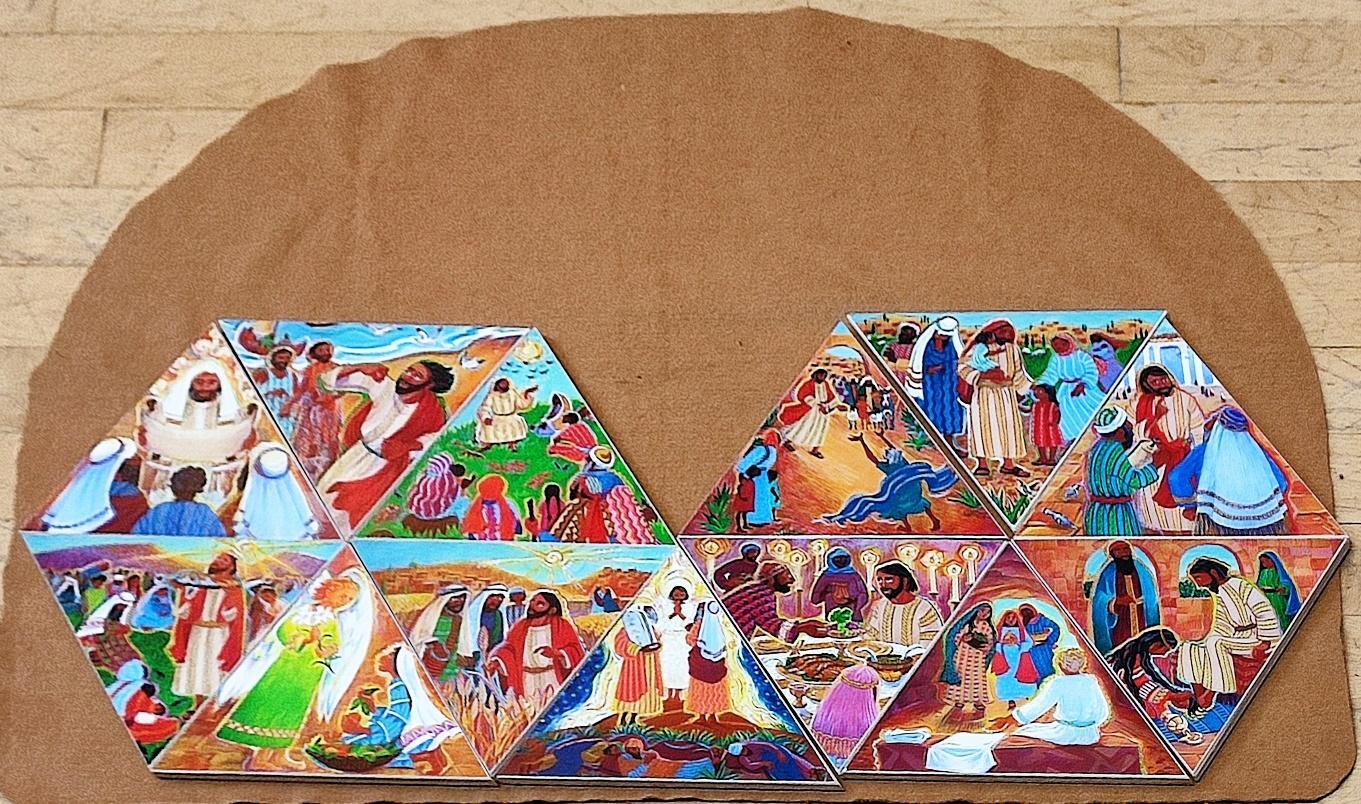
But how can the encounter between transcendence and immanence work? Berryman tells the story of Jesus here in an overly simplified manner using story materials made up of triangles that are attributed different theological meanings and painted accordingly. I refer to three of these triangles as “concept anchors”: Annunciation, Transfiguration, and Resurrection.Together they represent the effective incarnation of God in Jesus Christ. The remaining triangles represent encounters between the earthly Jesus and other people. But without the three concept anchors, these stories would lack the divine essence of Christ.
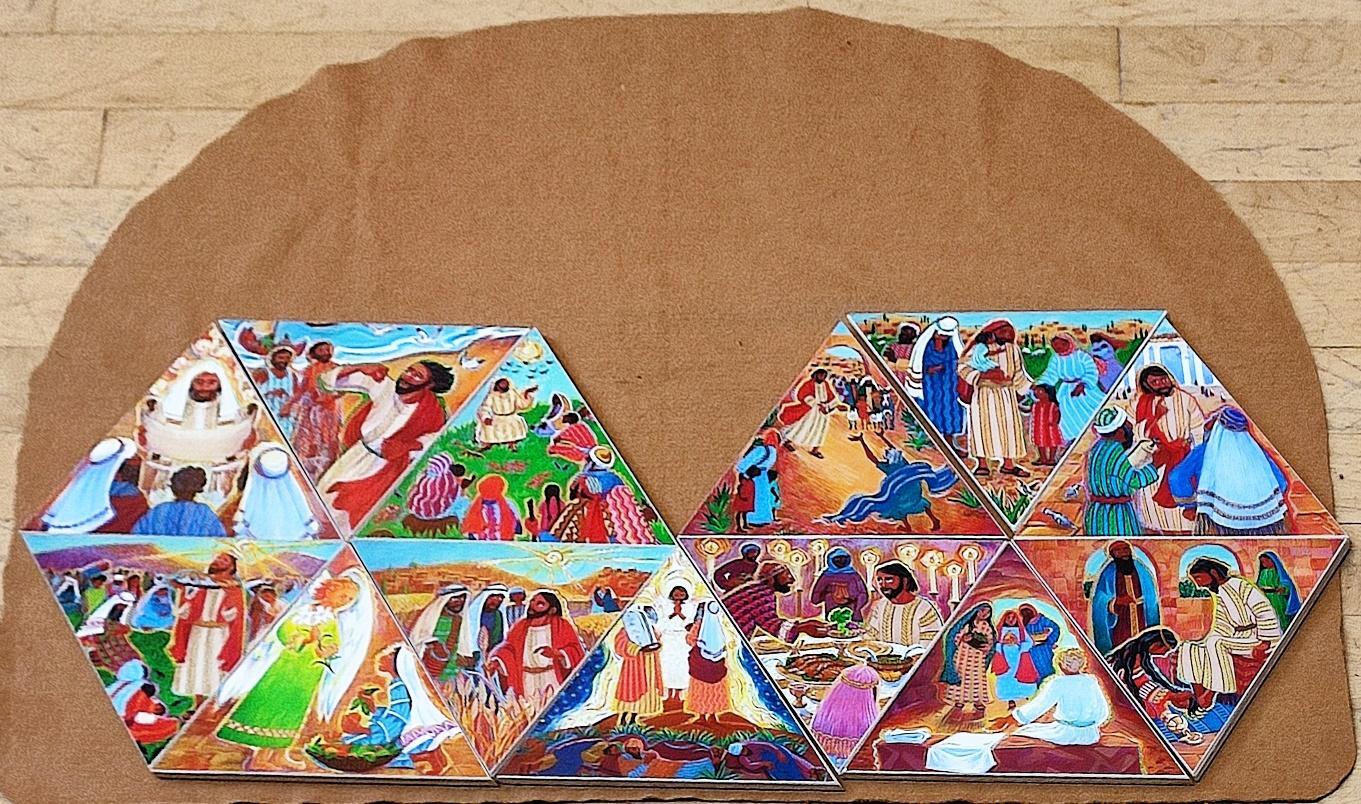
This series attempts to capture the “whole Jesus,” that is, the entire process of God’s incarnation in Jesus Christ, even if it means descending to the individual encounters described in the Gospel accounts. An aesthetic-liturgical form is used to approach the paradoxical construct of the divine-human unity of God in Jesus Christ from the perspective of revelation theology. From an educational perspective, I believe children might encounter various limitations with this parable due to the materials used. One possible limitation is that the triangles’ aesthetic form suggests what some might view as a constructivist model of thinking, which is not at all what it is intended to be.
The focus here, however, should be on the Christological content. The versions of “The Greatest Parable” in Berryman’s original volume 8, published in 2012, and in the revised volume, published in 2024, do differ, but the differences, when understood as signs of his creative process, reinforce Berryman’s Christology. Only in the original version of the lesson are parts of John 1, the central foundation of the Nicene Creed, quoted before the box is opened, and assigned a key hermeneutical function.[27] Incarnation is described here as the process of the never-before-seen God, in which the Word was already present at the beginning. This same God speaks everything into existence, but is himself so difficult to find in Creation that he incarnated himself as the Word. He who became a person continues the process of incarnation among us as we become children of God ourselves. This incarnation, which was initiated by the preexistent Word-Logos and continues to us, is, for Berryman, the gateway to the story of Jesus.
The fragile process of God’s elusive presence is described in a manner reminiscent of Terrien’s, yet it also differs from his. Berryman draws the structures of Annunciation, Transfiguration, and Resurrection from Terrien, whom he uses to describe the Christological part of his study.[28] However, in Terrien’s work, John 1 is only part of the Annunciation structure, “the tent of the presence” (John 1:14).[29] In contrast, Berryman sees it as the key to accessing Jesus Christ. Unlike Terrien, Berryman also extends the meaning of the word overshadow beyond the Annunciation and Transfiguration to refer to God’s actions on Easter Saturday. For Terrien, the verb is a clear code for God’s special presence in the historical figure of Jesus.[30] All of this suggests that Berryman (even more so than Terrien) wants to structurally link the historical person of Jesus to the Logos that existed before Creation, in the spirit of homoousios, without a temporal beginning or end through death and resurrection.
In this story, Berryman relies more on images and gestures than on words to convey the mystery of the Incarnation. In the original version of the story, the idea of continuing incarnation is clearly expressed with a set of gestures done silently—which are done at the beginning of part 1[31] and then again at the end of part 4 (the last part)—that seem to be the most important part of the story. The outstretched arms are meant to gather the entire room, the worship community, and the worldwide church together and lead them to the figure of Jesus in the story. At the end of the story, the triangles representing the Jesus stories form two hexagons, with one empty space between them. It is in this space, right next to the triangle of the Transfiguration, that the storyteller, with lowered hands, invites the children; this is their space. At the end, the storyteller turns their hands over and lifts them up in the air, symbolizing a connection to something higher, beyond the circle and beyond the materials. Perhaps it is a posture of prayer. This sequence of gestures is repeated in the fourth part of the story. It is interpreted as “pulling them [the children] into the story symbolically.”[32] In the revised lesson, published in 2024, the set of gestures appears in a shorter form at the end of the whole story cycle.
Several aspects of this guided experience make the ongoing Incarnation Christology concrete and place it in the context of other Godly Play stories: (a) the place of the children (b) “changes” as an ongoing transfiguration in the context of the “Holy Family” (c) sacramental anchoring.
The Designated Place of the Children
As mentioned above, the nonverbal gestures point the children to the only concrete space among the spaces filled with triangles representing concrete stories that have been deliberately left empty. This space can be interpreted in various ways, given the stories that border it: the Transfiguration, the Sermon on the Mount, and the healing of Bartimaeus. One can only guess why this empty space is meant for the children. There, in the center, in between the first and the last acts, close to the invisible transformation of Jesus, there may be an indirect task to fulfill. This task becomes clearer when we consider the story’s final gesture that accompanies it. The children are not only to encounter Jesus but also to experience internal change and be transfigured themselves. They are to perceive God’s incarnation in themselves and then act in their own lives.
Change as Continuing Incarnation—Transfiguration—The Holy Family as a Matrix
What does Berryman mean by transfiguration? The Christological interpretations of this story cycle center around the transfiguration of Jesus, a kind of “transubstantiation” of man (the Son of Man) into the Son of God while retaining the same form: “Jesus was changed, but the shape of his body, its figure, looked the same. He was transfigured.”[33]
Neither the appearance of Elijah nor Moses is explored in depth; it is simply stated that they lived hundreds of years earlier. Berryman has no interest in interpreting them as heralds of the end times or messianism. What is important to him is the interpretation of the Son through the voice that says, “This is my beloved Son. Listen to him.” Terrien’s interpretation of this passage, with a similar emphasis, leads to a different conclusion: “He was the reflector of the glory of God, but the reflection of this glory led to Jerusalem and to his own death.”[34] Berryman’s statement about Jesus’s appearance (“Jesus was changed - but the shape of his body, its figure, looked the same”) during the Transfiguration uses language similar to the transubstantiation of the gifts at the Lord’s Supper. It tells of a kind of personal transformation in the very essence of Jesus. One wonders what kind of transformation this could be, since he came from God at the beginning, as God incarnate? Could it possibly be a paradigm of a different kind of transformation? At this point, the incarnation of Christ continues into pneumatology: change (transformation, alteration, fundamental change) is a word that Berryman uses frequently and on specific occasions. It is used in reference to Jesus, but also to the people close to him and to those listening to the stories today. This observation leads to the idea of transubstantiation, or sacramental transformation. It is then applied to the spiritual and mental processes of transformation, or in other words, “transfiguration.”
Telling the story of “The Holy Family” to children several times a year is meant to keep it alive in their awareness. Berryman writes that it is meant to instill in them the “matrix” of the Incarnation, from before creation to the - with no end - into their lives.[35] In telling the story of the Incarnation through “The Holy Family,” a re-creation takes place. The Incarnation should transform us, our spirituality, and our understanding of ourselves and the world. Its integration in the liturgical transformation of Christ as embodied in the church year, with the help of nativity figures, is intended to transform the children themselves; one could also say that it is intended to “sanctify” them. In “The Greatest Parable,” this understanding of continuing incarnation in the lives of children is presented as a paradigm not only for the newborn Jesus but also for the adult Jesus, the Son of God. With a gesture, the children are assigned a special place near the Transfiguration, which they can enter. They, too, are to be transformed or transfigured.
Sacramental Anchoring and Redemption
It can be assumed that the structure of “The Greatest Parable” must remain constant because there is an invisible counterpart at work, namely, the Episcopal liturgy of the Eucharist based on a particular form of Christological-ecclesiological cantus firmus. It seems to say that the liturgy should be remembered in the Godly Play room and, conversely, the Godly Play lesson should be remembered in the Eucharist. The first version of the closing gesture clearly recalls the lifting up of the gifts in the eucharistic celebration. Here, as in “Faces of Easter VI,” a special reference to the sacrament is evident through the symbols of bread and wine.[36] However, Berryman is not primarily concerned with the redemptive work of Jesus Christ through his death on the cross and the forgiveness of sins that thereby occurs: “On Good Friday he died on the cross for us and was put in a rock tomb.”[37] The formulaic nature of the description of death is reminiscent of the Nicene Creed: “and was crucified for us under Pontius Pilate, and suffered and was buried.” Here too, we find in the repeated “for us” a continuation of the gift of the Incarnation for us without beginning and without end. “For us and for our salvation he came down from heaven,” says the Nicene Creed. It seems that Berryman obviously understands the death of Jesus in this way, as a continuation of the Incarnation, as the continuing and special presence of God. That the goal is a continuing incarnation of God in the children and in us will be shown in the following section.
“Knowing Jesus in a New Way”: Continuing Incarnation in an Ecclesiological Context That Includes Children as Co-Creators
This series of seven stories traces the journey of the disciples with the risen Christ from Eastertide through Pentecost, and it is described in the foreword as a continuation of “Faces of Easter.”
In the wondering for this story, like in “Faces of Easter,” the children are asked to select material from the Godly Play shelves in the room, “to help us tell more about this part of the story.”[38] This type of wondering, as well as the subsequent interpretation of the triangular picture-panels, suggests that Berryman’s motive is to extend the effect of the Incarnation to children as well.
The pictorial representations of this series of stories are intended to follow on from the “Faces of Easter” and show the presence of the risen Christ in the faces of the disciples. These take on the meaning of becoming bearers of God’s presence, as when Moses talks with God “face to face” (Exodus 33:11) or when he emerges from God’s presence in the tent of meeting (Exodus 34:34). “Jesus’s presence is suggested by the faces of the disciples,”[39] and the children are invited to look into the perplexed and astonished faces of the disciples to see Jesus in this new way. “This new way”—what does that mean? Here, in my opinion, Berryman refers not only to Exodus 33 and 34 but also to Terrien’s interpretation of these very passages in the Pauline context of 2 Corinthians 3:18: “While we reflect as a mirror the glory of the Lord, we are being transfigured” in such a way that this supreme God can only be “seen” “under the image of the debased and humbled Jesus.”[40]
Throughout this series, Berryman lets the children take the place of the Twelve (Jesus’s twelve disciples). They, too, are to become bearers of the continuing incarnation-transfiguration. The disciples repeatedly experience Jesus’s presence. They feel it, and even understand the words, but they themselves are not yet ready, and initially it is their sudden awareness or their being “more comfortable” that is mentioned.[41] The regular exhortation to the children before every Godly Play presentation that begins with “We all need to be ready” is clearer in this light. We should become ready ourselves.
Four of the seven stories recount a meal with the risen Lord, two mention baptism, and others include communal prayer, blessing, and the greeting of peace. Christ makes himself present in the community of disciples and, as a result, in the community of children. He is, however, present in a “changed” form. Here, as in Berryman’s entire body of work, there is no expectation of Christ returning at the end of time. Even though Matthew 28 is quoted: “I am with you always, even unto the end of the age,”[42] the word "always" is emphasized, thus preventing any assumption that he will return at the end of time. Christ’s return becomes present now in the presence of the children. On the one hand, this occurs in liturgical acts such as Communion, prayers, blessings, and baptisms—even baptism with fire at Pentecost—in the presence of the with-us-present Jesus. On the other hand, it also occurs in the myriad of small steps that make up “getting ready.” And it also happens when children can discover their own connection to the stories through the materials offered in the Godly Play room. In addition, the forewords to these presentations repeatedly offer this interpretation: “They had to create God’s creation anew, as we must also do in our time, guided by Eastertide and Pentecost.” Here we see the transition from Christology to pneumatology. The incarnate God takes his place among the children in the group, among God’s creatures, among the community of people, who in this way are to become co-creators. They themselves are transformed. Where this transformation takes place, it is no longer solely about the preexistent God before Creation or the Incarnation of God in Jesus of Nazareth. It is now about God’s continuing incarnation in the children that moves toward a Spirit-inspired new creation of the world. This new creation is already beginning now in the present, and therefore, we can speak of a present eschatology in Berryman’s work.
Outlook: Face Transfiguration in the Theological Context of Revelation Theology
When Berryman cites Exodus 33 and 34 in the foreword of the series of lessons called “Knowing Jesus in a New Way,” it is about more than how to use the material.[43] It concerns God’s revelation to humanity; it is about the invisible becoming visible, transcendence within world immanence, about accessibility to a mystery. Berryman’s interpretive treatment of the “Faces” in both major Jesus story cycles can be understood in terms of revelation theology. To Berryman, it is about an “intimate presence” or “face to face” space, meaning a space with Jesus into which he invites the children.[44] Where Terrien states that Jesus is the “reflector of God’s glory,”[45] Berryman would write that not only is the divine child Jesus a reflector of glory, but every child is as well. This is the distinctive feature of his Christology: since Christ’s essence is anchored in God even before creation, Christ is also present in everything that is created, both visible and invisible, and is mysterious, like the whole Incarnation. The transcendent God is immanently transcendent from the beginning. It is for this reason only that the “face-to-face” encounter of the children with Jesus Christ is possible on the basis of the Incarnation. The earthly Jesus, in his immanent perceptibility, can take a back seat to the narrative’s quantitative importance because there is also the “pre-earthly” Jesus, who is the greatest gift even before creation, as the matrix of the “Holy Family” and of God’s presence in the desert. The whole God is there as a great diverse spiritual force, and with him the whole Christ is immanently-transcendentally present. It is a powerful Christology that draws children and adults into the spell of these stories when they realize they can experience this closeness and that it can grow in them.
An important category for Terrien is the recognition or knowledge of God.[46] Even though knowledge of God is often discussed as an “experience,” it is still a category of revelation theology. Terrien often underscores in the testimonies of early Christians a kenotic way of knowing God with reference to Christ.[47] The same cannot be said about Berryman. It is more appropriate to say that he would characterize it as mysterious and often hidden, yet potentially already revealed. The co-creation of the children and their own transfiguration (2 Corinthians 3:18) constitute the “face to face.” To Berryman, this is the interface between Christology and pneumatology.
This is one side of Berryman’s Christological arc. We see the other side of this arc where the transcendent immanence of the risen Christ is concerned. Because the preexisting Christ ultimately needs to be more present and tangible, he is sacramentally anchored in the Eucharist, in liturgical forms and words. Here too, he follows Terrien, who emphasizes a great diversity of openness in the experience of the Eucharist for early Christianity as a foretaste of the heavenly banquet.[48] In Berryman’s view, though, the great approachability of the preexistent Christ is too closely and concretely linked to specific liturgical forms and experiences in the liturgical Jesus stories, which have a sacramental connection. Even if the statement “I am here” is sufficient for him in the Eucharist, Christ’s presence is only relevant for listeners if they also belong to the eucharistic community. For people who, because of their secular socialization, are unable to relate to the language of colors and forms evoked in the liturgical acts, the impact of this sacramental Christ is limited to occasions when those forms resonate with the everyday reality of their lives.
As other contemporary Christologies of incarnation show, it is both a fundamental problem and an opportunity for a Christology that emphasizes the preexistent Christ of incarnation to clarify this great openness or transcendence within world immanence. To contrast and broaden the Godly Play perspective, I would like to cite the comparable yet completely different work of Sallie McFague. Specifically, in her book The Body of God, the “cosmic Christ” is embodied entirely in nature, not merely present in the human world. In her examination of Exodus 33 and 34, she differentiates between “the face and back of God.”[49] All the suffering of the world can be seen on the back of God, which is also a part of God’s body. To McFague, incarnation is also linked to the second person of the Godhead. She also understands this incarnation to extend beyond the unique person of the historical Jesus of Nazareth. In addition, she allows her Christology to shift almost imperceptibly into a pneumatology that emphasizes the sacramentality of creation in relation to others, with ethical consequences. She, too, is critical of the distinction between “of God” and “not God” in the world. McFague offers us the opportunity to open incarnation to a universal, pluralistic perspective by honoring the entire natural world.
Berryman honors children with both aspects of his Christology of revelational theological appreciation. The mystery of incarnation in a theological figuration is not limited to a child’s horizon of knowledge and experience. Instead, it even becomes embodied in the children in a prominent way. This is indeed a unique achievement.
Samuel Terrien, The Elusive Presence: Toward a New Biblical Theology (New York: Harper & Row, 1978), 475.
Sallie McFague, The Body of God: An Ecological Theology (Minneapolis: Fortress Press, 1993).
Jerome W. Berryman*,* “Faces of Easter,” in The Complete Guide to Godly Play, vol*.* 4, revised and expanded ed. (New York: Church Publishing, 2018), 33–81; Berryman*,* “The Greatest Parable,” in The Complete Guide to Godly Play, vol. 8, revised and expanded ed. (New York: Church Publishing, 2024), 25–61; Berryman*,* “Knowing Jesus in a New Way,” in Complete Guide to Godly Play, vol. 8, 95–156.
Jerome W. Berryman*,* “Creation,” in The Complete Guide to Godly Play, vol. 2, revised and expanded ed. (New York: Church Publishing, 2017), 63–73; Berryman*,* “The Holy Family,” in Complete Guide to Godly Play, vol. 2, 55–62; Berryman*, The Complete Guide to Godly Play*, vol. 3, rev. and expanded ed. (New York: Church Publishing, 2017), 97–156.
Cheryl Minor, “Why Are the New Testament Materials Flat?” workshop presented at the Edinburgh European Godly Play Trainers’ Conference, 2024.
Minor, “Why Are the New Testament Materials Flat?”
Jerome W. Berryman*,* “Circle of the Holy Eucharist,” in Complete Guide to Godly Play, vol. 4, 138.
The Nicene Creed, in The Book of Common Prayer (New York: at Church Publishing, 1979).
Wolfgang Ullmann, Εἷς ὁ Θεὁς—Der Eine Gott: Die Geschichte von Dogma und Bekenntnis der Kirche, vol. 2 (Würzburg: Echter, 2020), 78.
Athanasius of Alexandria, Discourse I Against the Arians, in A Select Library of the Nicene and Post-Nicene Fathers of the Christian Church, ed. Philip Schaff (New York: Christian Literature Co., 1892), sec. 2, https://www.newadvent.org/fathers/28161.htm.
Berryman, " Greatest Parable"; and Minor, “Why Are the New Testament Materials Flat?”
Minor, “Why Are the New Testament Materials Flat?”
Berryman*,* “Faces of Easter.”
Berryman*,* “Faces of Easter,” 6*.*
Berryman, 77.
Berryman, 78.
Berryman, “Faces of Easter,” 36.
Berryman*,* “Creation,” 63–73.
Berryman*,* “The Holy Trinity,” 181ff.
Berryman*,* “Creation,”,.
Berryman, “Creation” .
Berryman*, Complete Guide to Godly Play*, vol. 3, 97–156.
McFague, “Speaking in Parables”, 71.
Berryman, “Faces of Easter,” 63 ,,.
Berryman, " Greatest Parable," 26.
Revelation theology is a branch of Christian theology that focuses on how God reveals himself to humanity—both the content of that revelation and how it is made known.
Berryman, " Greatest Parable," 37.
Terrien, Elusive Presence, 411ff.
Terrien, Elusive Presence, 417ff., 473ff.
Terrien, 426.
Berryman, " Greatest Parable."
Berryman, 61.
So written in the original version of 2012, 39.
Terrien, Elusive Presence, 427, discussing 2 Corinthians 3:18.
Berryman, " Holy Family," 55.
Berryman, “Faces of Easter,” 59.
Berryman, Vol.8 (2012), 39; Vol.8 (2024),43.
Berryman, “Knowing Jesus in a New Way,” 95ff.
Berryman, “Knowing Jesus in a New Way,” 104.
Terrien, Elusive Presence, 457.
Berryman, “Knowing Jesus in a New Way,” 95ff.
Berryman “Knowing Jesus in a New Way” 135.
Berryman, 138.
Berryman, 138.
Terrien, Elusive Presence, 425.
Terrien, 40.
Terrien, 427.
Terrien, 466.
Sallie McFague, Body of God, 133.