In his early twenties, while studying at Princeton Theological Seminary, Jerome W. Berryman (1937–2024) wrote a paper called “The Direct Perception of God through the Sacraments in Christian Education” that would quietly shape the rest of his life’s work.[1] At a time when Christian education in North American Protestantism was becoming increasingly focused on developmental psychology, curriculum design, and teaching techniques, Berryman stepped back and asked a more basic question: How do people actually come to know God?
Instead of beginning with a method, he began with experience. Drawing on the 1934 Gifford Lectures of philosopher Edwyn Bevan, Berryman explored the idea that belief in God cannot rest on argument alone.[2] Bevan said that rational people cannot sustain a belief if it feels disconnected from their understanding of reality. When belief is treated as a hypothesis competing with other explanations of the world, it becomes fragile. For Bevan, faith does not ultimately grow out of proof but out of encounter. What leads a person to believe in God, he wrote, is “direct perception of the Divine.”[3]
Berryman took this claim seriously and asked what it might mean for Christian education. Could this “direct perception” happen through the sacramental life of the church—through ordinary elements like bread, wine, and water? In many Protestant settings, these elements were mainly seen as symbols. But Berryman wondered if they might do more than just symbolize God’s presence. What if they mediated presence? What if they were places where an encounter with God could happen?
If that were true, then education could not simply be the transfer of information, moral instruction, or the clear explanation of beliefs. It would have to involve shaping the conditions under which an encounter becomes possible: attention to symbol, space for mystery, practices that invite perception rather than rush toward explanation. Even at twenty-three, Berryman was already circling what would become central to his life’s work—that knowledge of God begins in participation before it becomes conceptual. In his book Teaching Godly Play: How to Mentor the Spiritual Development of Children, first published in 1995 and then revised and expanded in 2009, he wrote:
Most theory and research in education is based on models that do not allow for God’s presence as part of the process. When secular theory and research are imported into religious education the ultimate variable, God, is not accounted for.[4]
This paper argues that Berryman’s early epistemological reflections on encounter and sacrament provided the theological foundation for the later development of Godly Play.[5]
Berryman frequently recounted the circumstances surrounding the paper’s composition, suggesting its importance in his own retrospective interpretation of his work. Berryman told the story of how, as a student in a required introductory course in Christian education, he became increasingly dissatisfied with what he experienced as an overemphasis on technique and developmental systems. He would later write in his book The Spiritual Guidance of Children, published in 2013,
Attacking the Sunday school is easy. Most experienced Christian educators are more aware of the paradoxes and problems involved in their work than their critics (see the work of Westerhoff, for example). What is difficult to do, however, is to present a detailed alternative to the status quo with a method, curriculum, theoretical foundation, and history to deepen or even reframe the discussion about what is best for the spiritual quest of children. Godly Play is an effort to provide a well-developed alternative to the schooling and socialization models.[6]
His questions at Princeton, persistent and perhaps a bit impertinent, eventually led his professor to suggest that he withdraw from the course and pursue an independent study with Cam Wyckoff, the head of the department.[7] In other words, he was such a problem that the professor kicked him out of the course!
Wyckoff’s response to the finished paper was remarkably perceptive:
You have built an interesting and potentially fruitful base for a theory of Christian education. You leave me rather convinced that the heart of the matter is an epistemology. . . . From this base, you could proceed to a theory of learning, then to an educational methodology. . . . I hope that in time you will do so.[8]
In many ways, Berryman’s career can be read as his steady response to that invitation.
Dialogue, Mystery, and Epistemology
One of the most striking features of Berryman’s early paper is its breadth. He does not limit himself to theology but engages philosophers, psychologists, and mystics as conversation partners. This grows out of a deep conviction about how we know anything about God in the first place—an epistemological claim as much as a pedagogical one. For Berryman, knowing God isn’t about collecting information or lining up the right statements. It grows out of encounter, through participation, lived experience, and the meaning carried by symbols. Theology, in this sense, is grounded in a way of knowing that precedes analysis.
For Berryman, such knowledge cannot be contained within a single discipline or reduced to a set of tidy propositions. If faith arises through encounter, then understanding it requires listening across boundaries and remaining open to symbolic, relational, and experiential forms of knowledge.
Implicit in this approach is also a deep respect for children themselves. They are not treated as passive recipients of information about God, but as full participants in the human search for God, persons whose experiences and perceptions deserve the same seriousness granted to academic voices. Berryman’s epistemology, then, has anthropological implications. Here, anthropology refers to the study of human beings, their capacities, nature, and ways of engaging with the world, showing that how we understand knowledge also shapes how we understand the human person, including children. In other words, if knowledge of God is grounded in encounter rather than argument, then children are genuine knowers. In this sense, the paper already gestures toward a critique of more traditional approaches to formation that underestimate children’s spiritual capacities by equating knowledge with explanation or verbal agreement.
This dialogical spirit would later shape works like Children and the Theologians, where Berryman engages major theological voices as conversation partners in articulating a doctrine of children within the Church. Berryman writes in the preface to Children and the Theologians, “The themes that emerged from this study came into view slowly from wide reading across many decades.”[9] In his hands, theology becomes less a closed system and more an open conversation—serious, playful, unfinished.
Berryman’s process took concrete form in his personal library, now housed in the offices of Lifelong Learning at Virginia Theological Seminary. The collection mirrors the scope of his epistemology and pedagogy, with sections including theology, philosophy, psychology, mysticism, imagination, story, play, childhood and development, spiritual formation, and more. Fifty years later, this library reveals how his intellectual commitments became embodied in practice. It reflects the conversations and disciplines that shaped his theology and pedagogy.
Sacrament and the Limits of Explanation
In his Princeton paper, Berryman wrestles with how humans come to know God and carefully examines whether the sacraments mediate that presence, asking, “What exactly do people encounter in the sacraments?” After reviewing theological, philosophical, psychological, and mystical accounts of religious experience, he refuses to settle the question quickly. Is it the Christian God (the theologians), the mystic’s One, the unconscious (the psychologists), or something else entirely? He does not force an answer, writing,
We must say . . . that no single debate has proved conclusive nor has any single point of view overwhelmed us with its exclusive truth. Rather, each way of seeing life points deeply into the unknown forces of our human existence, which are known only by their pressures on us.[10]
This hesitation reflects what he cultivated throughout his whole life, a kind of humility before mystery. Religious experience, Berryman suggests, is best recognized by its effects on the person—through transformation, wholeness, or deepened peace—rather than through precise identification of its source. Understanding, at this level, comes through lived reality before it comes through definition.[11]
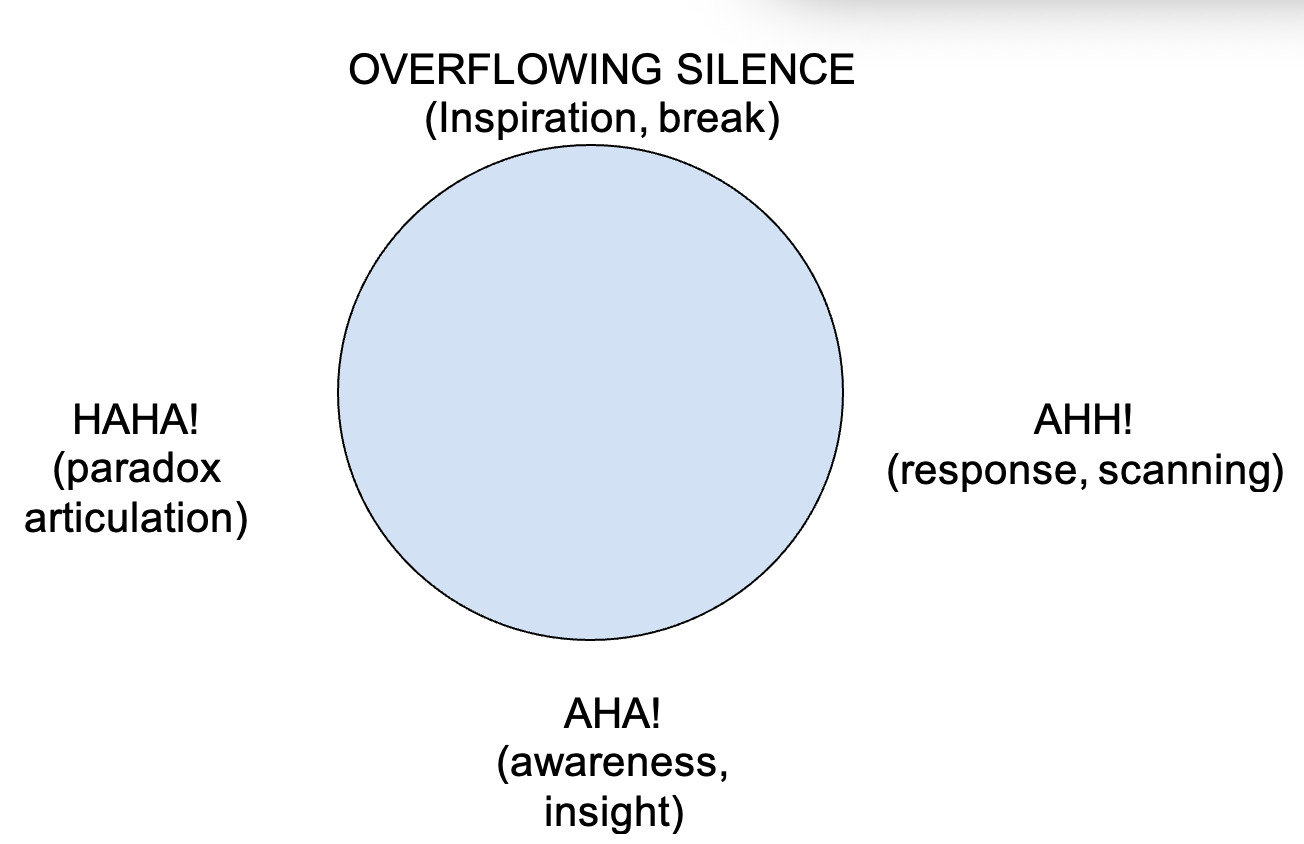
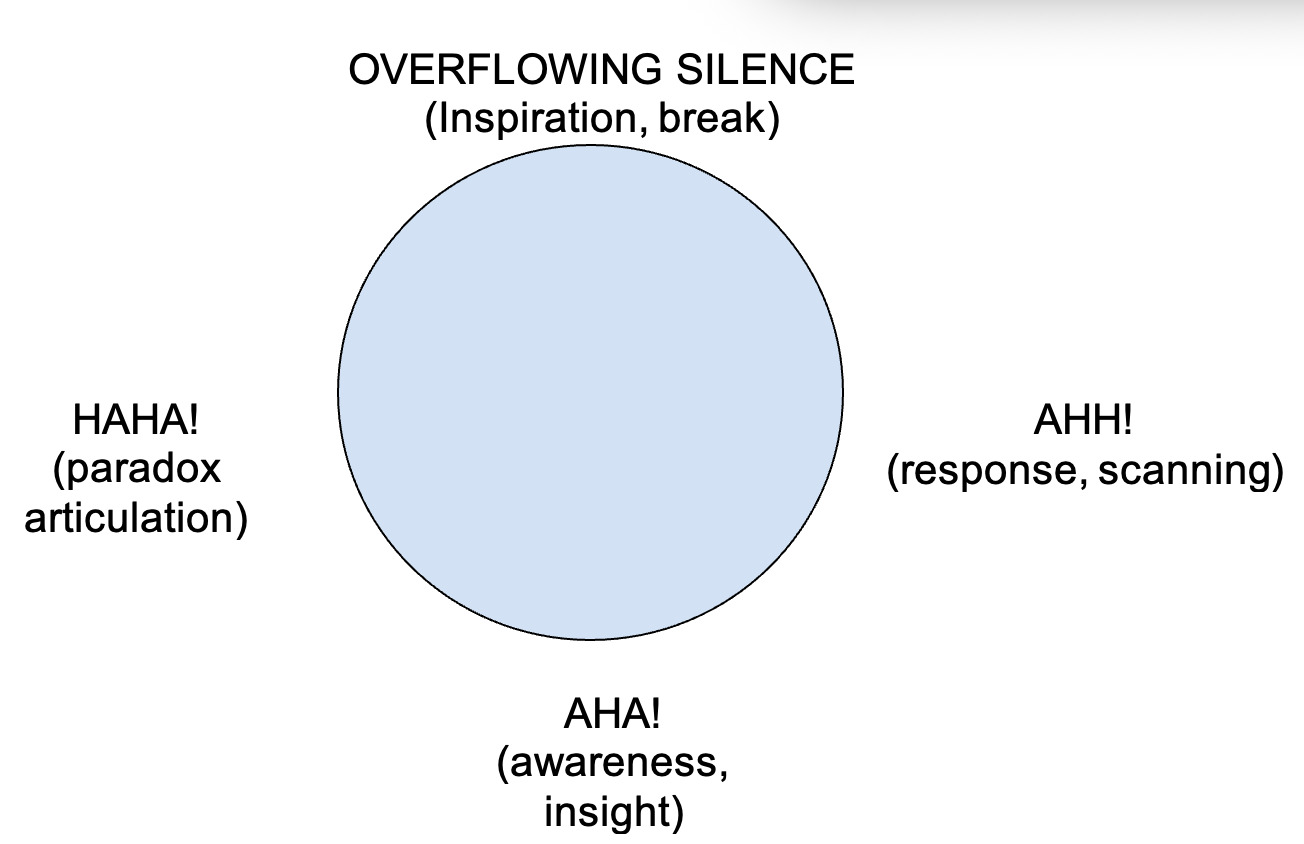
One can see Berryman struggling to work out a way to describe this for his followers. He draws an image of the experience he is trying to understand in his 1991 book Godly Play: A Way of Religious Education (see Figure 1):
First, a sound like “AHH!” can be heard. This sigh suggests the presence of a nourishing mystery that feeds and yet overwhelms us with awe. The awe shades into another experience that involves more awareness of what is going on. We might say, “AHA!” The expelling of air now has an inflection in it. This exclamation indicates that we have identified the experience. . . . The third step in this awareness is to sense the paradoxes about knowing God. We realize that to be aware of knowing God means that we have already stepped out of the primary experience itself. . . . These discoveries erupt into “HAHA!” . . . Sometimes we even laugh until we cry or cry until we laugh. . . .
These experiences can be shown in a kind of feedback loop. The primary experience shades into awareness of the experience, and then into awareness of the paradox that binds the experience of God. To know is not to know the Holy One.[12]
From this insight, Berryman’s Princeton paper makes one of his boldest claims: The sacraments do not convey explanations; they convey reality. They are not visual aids for doctrine. They draw people into participation. What they communicate is not merely information but a way of living and being. He writes,
We have abundantly seen that the sacraments convey much more than a theological description, a philosophical analysis, or a psychological system. They convey the Event, a state of being, a valid existence, a transformed way of living that touches the realized Self, the One.[14]
He connects this to a wider concern about Protestantism’s uneasy relationship with symbols. Drawing on Carl Jung, Berryman observes that iconoclasm may have diminished the church’s symbolic imagination.[15] When symbols lose their power, we tend to replace them with explanations—and the more we explain, the less they seem to speak on their own. As he observes,
The present course of Christian education, then, is valid and most exciting when it emphasizes the value of symbols, especially the sacraments. In these “irrational” ways come the deep rivers of life which fill with meaning the more rational words we spend most of our time using to teach with.[16]
The emphasis on engaging with symbols in real life naturally informs the Godly Play approach. Throughout his career, Berryman frequently described the structure of the Holy Eucharist as a pattern for shaping children’s time in religious education. The events of a Godly Play session reflect the order of an Episcopal worship service, and even the room itself is designed to embody the same theological priorities. He writes in Godly Play,
Godly play attempts to create a situation where wonder, community, an awareness of existential limits, religious language, the creative process, and the structure of the holy Eucharist work together to enable the child to enter religious language in order to make meaning and find direction with God in life and death.[17]
Encounter and the Role of the Adult
If knowledge of God begins in direct perception, then the adult’s role cannot be to supply meaning. Again and again, Berryman speaks about this in his early books about the Godly Play method, insisting that the storyteller must “get out of the way.” He writes in Godly Play,
To enable the group to be more creative and alive, one must become the servant of the group and almost disappear in it. Praise is no longer directed to the teacher. It is directed to the children who are working on their own within carefully crafted, clear, constructive limits. This means that the art they learn, the experience of the community, and the experience of God, is theirs. It is primary. It is not a secondary kind of hearsay evidence filtered through the adult’s experience and told to them.[18]
In Godly Play, the adult prepares the space, tells the story carefully, and then steps back. Meaning, suggests Berryman, must be discovered, not delivered.[19] This approach certainly aligns with constructivist theories of learning, but it runs deeper than pedagogy. It rests on the conviction that imposed explanations can interrupt encounters. Religious language must emerge from lived engagement with story and symbol. Seen in hindsight, Godly Play is the natural outgrowth of a question Berryman first asked at Princeton: If people come to believe through direct perception of the Divine, how should we teach?
Berryman’s answer, developed over decades, remains consistent with his youthful insight at Princeton. Encounter precedes explanation. Participation comes before definition. The task of Christian education is not to solve the mystery of God but to make space where that mystery may be met. Berryman describes this as the “still point,” saying, “Godly Play mentors need to be able to identify this still point in their own experience so they can help children find it by showing it to them rather than by talking about it.”[20]
Mystery as a Pedagogical and Theological Principle
At the heart of Berryman’s understanding of how a person encounters the Divine is his steady attention to mystery. From his early reflections on mysticism to his mature vision of Godly Play, mystery is not something to be solved or filled in. It is a basic and necessary part of faith and of the way we learn. In the Princeton paper, Berryman draws on mystical writers to show that knowledge of God arises less from concepts than from lived encounter, highlighting the transformative and participatory nature of spiritual experience. He writes,
Since we can know these deepest pressures only by their manifestations described as “fruits of the Spirit,” aesthetic impressions, transformation, obsessions, or the Event of union with the One, it is beyond our capacity to pontificate on what lies behind these pressures. We can only know that the vast creative and destructive powers in life reign eternally within us and about us.[21]
For Berryman, God cannot be contained by tidy concepts or mastered through explanation. That conviction shapes the way he thinks about Christian education. If God exceeds our grasp, then teaching should not rush to clear up every ambiguity.
Here, the theological foundation of Godly Play is already visible. In Godly Play, children are introduced to biblical stories, parables, and liturgical actions without having everything spelled out for them. In Teaching Godly Play, Berryman writes,
The main difference between Godly Play and a transfer model involves who is doing the generalizing from experience. The Godly Play presentation invites the children to generate meaning from the interplay between their life experience and the sacred story, the parable, the liturgical action or the contemplative silence involved in the presentation.[22]
The material elements of Godly Play—figures, objects, and gestures—support engagement with mystery by allowing multiple layers of interpretation to coexist. Children are encouraged to revisit the same stories, discovering new insights each time. This practice further echoes the mystical perspective he explored early in his career—that understanding unfolds through participation, reflection, and repeated encounter rather than through final, propositional answers.
The mentor’s choice to withhold what they perceive as a definitive answer is crucial. By avoiding premature closure, the adult safeguards the child’s authentic engagement with the sacred. Meaning that arises through encounter rather than instruction has a depth and durability that explanation alone cannot achieve.
Wonder as a Way of Knowing
At the center of Berryman’s commitment to mystery is an equally strong commitment to wonder. In his early work, wonder is treated as the starting point of meaning, echoing the older philosophical claim that knowledge begins in wonder. In his Princeton paper he makes a passing comment about wonder as he explores mysticism and encounter with God. Quoting Ananda Coomaraswamy, he shares,
It is one of the prime errors of historical and rational analysis to suppose that the “truth” and “original form” of a legend can be separated from its miraculous elements. It is in the marvels themselves that the truth inheres: “Wonder”—for this is no other than the very beginning philosophy, and in the same way Aristotle, who adds, "So that the lover of myths which are a compact of wonders, is by the nearest approach to absolute truth that can be stated in words.[23]
Later in his development of Godly Play, wonder becomes a hallmark of the approach. The “wondering” questions that follow a story make this clear. When the storyteller asks, “I wonder which part of the story you like best?” or “I wonder what this story tells us about God?” the goal is not to reach a correct answer. The questions are left open on purpose. They slow the room down, invite reflection, and encourage attentiveness and humility. In Teaching Godly Play, Berryman describes the wondering in Godly Play in his way:
There is a great difference between transferring units of knowledge—such as “biblical facts”—and what happens during the wondering. Wondering opens the creative process and draws both the lesson and the child’s life experience into the personal creation of meaning.[24]
In this way, Godly Play does more than teach content; it embodies a way of knowing. It rests on the idea that understanding develops through receptivity, patience, and a willingness to engage what we do not fully grasp. Wonder is more than a fleeting feeling; it is a sustained practice that keeps us open to encounters and mystery rather than shutting them down.
It is important to note that, as Berryman worked with wondering to engage children, he was very careful to keep it open. He often writes about the difference between, for example, the Socratic method of teaching and asking questions, and the wondering in Godly Play:
Teachers using the Socratic method move students toward the concept being taught by asking strategic questions. (This skill is most visible in legal education and in court during the examination of witnesses.) The general difference between a Socratic strategic question and a Godly Play wondering is that the teacher knows where the Socratic questions are leading, while wondering does not. Wondering is not really a question at all, is it? A question implies an answer but wondering implies more wondering.[25]
The Princeton paper foreshadows how, in Godly Play, wonder becomes a practice that fosters openness, reflection, and encounter.
Conclusion
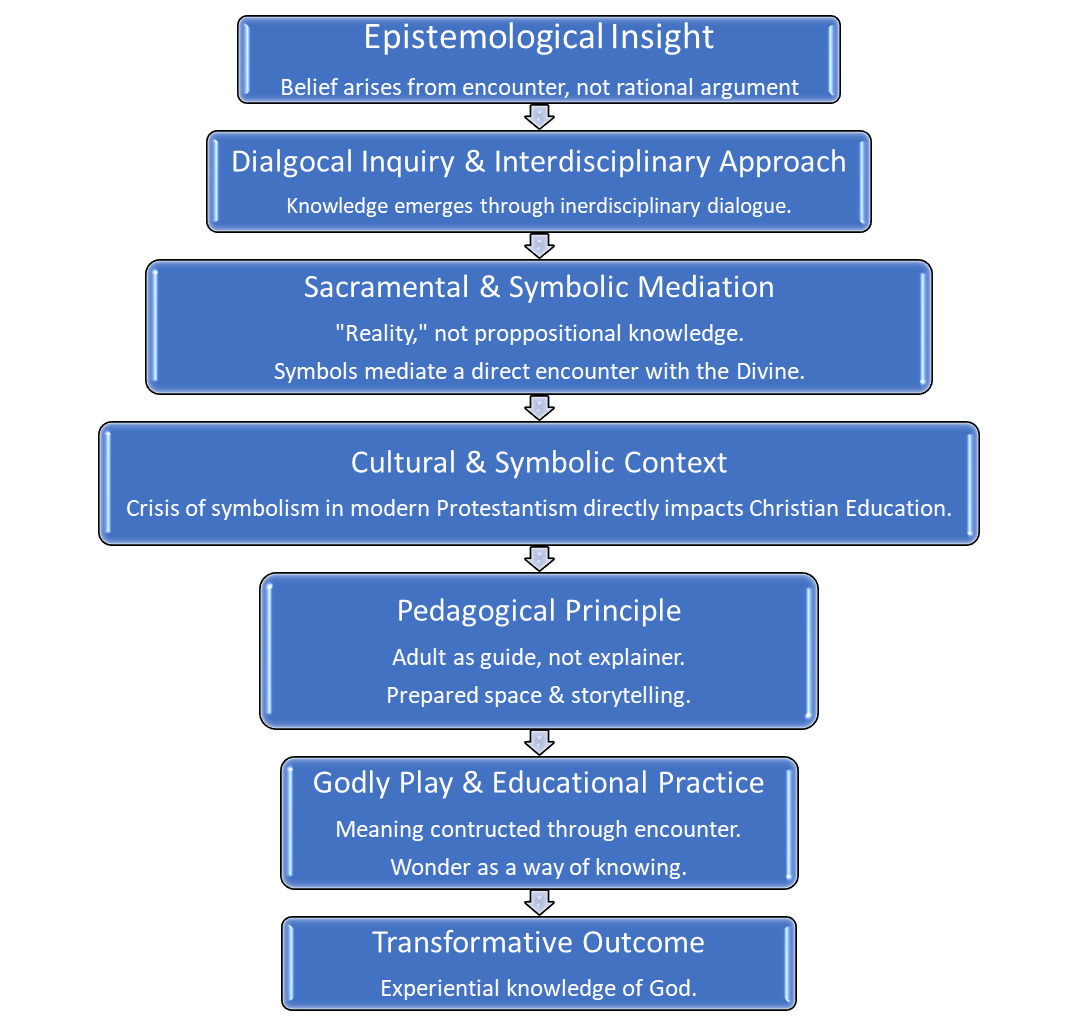
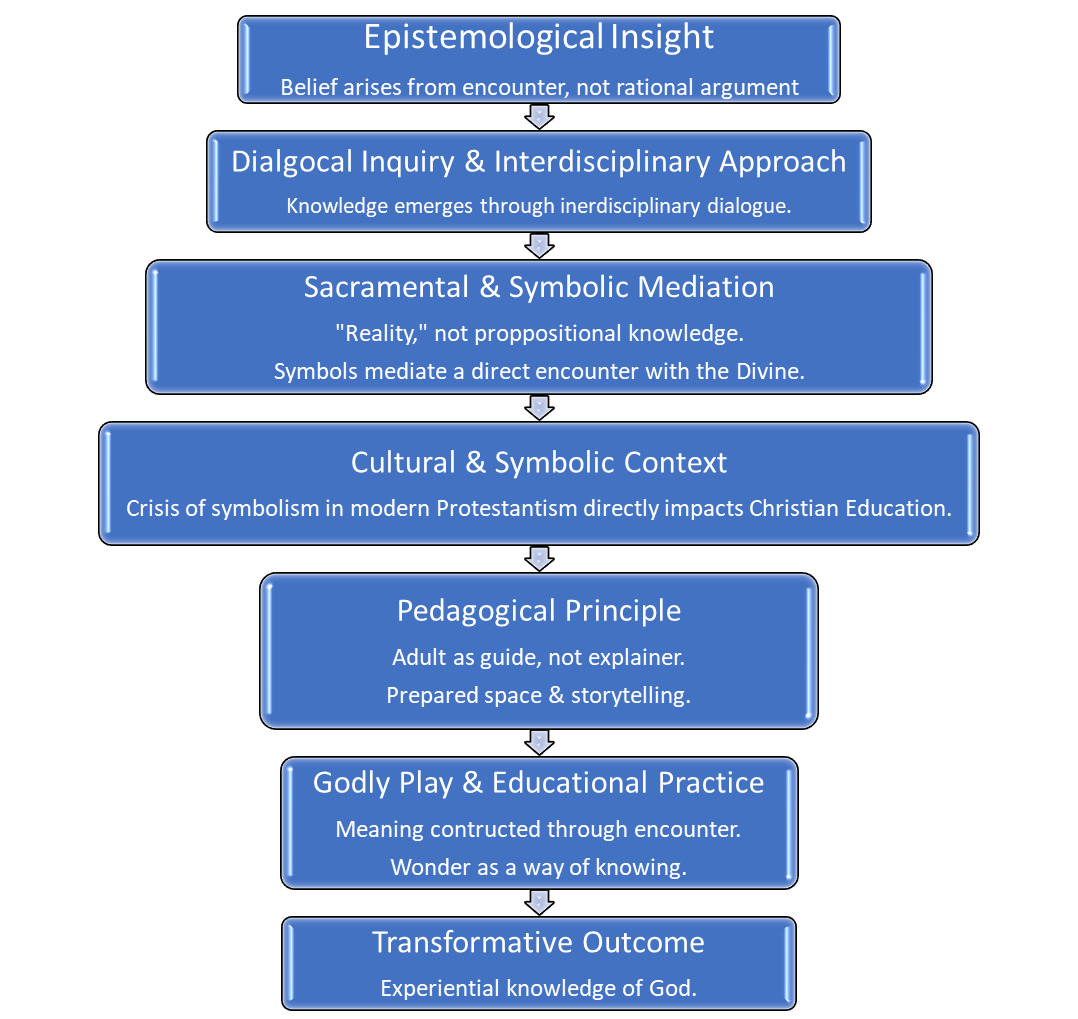
Berryman’s early Princeton paper reveals the conceptual foundations of a lifetime of theological and pedagogical work. His engagement with Bevan’s account of religious perception, combined with his sacramental imagination, led him to identify encounter as the epistemological core of Christian education. From this foundation emerged a theory of learning, a pedagogical method, and ultimately a practice that has reshaped Christian formation for children across denominations. (See Figure 2 for a clear mapping of Berryman’s work from the Princeton paper all the way to the mature development of Godly Play.)
Cam Wyckoff’s early assessment proved accurate. What began as a young seminarian’s dissatisfaction with reductive educational models developed into a coherent and influential vision of Christian education—one that honors mystery, cultivates wonder, and trusts children as capable participants in the direct perception of God.
Jerome W. Berryman, “The Direct Perception of God through the Sacraments in Christian Education,” Jerome Berryman Archive, Godly Play Foundation, Ashland, KS. Written in 1960, this paper has been published as part of a special issue of the Journal of Childhood and Religion, 2026, http://www.childhoodandreligion.com.
Edwin Bevan, Symbolism (Boston: Beacon Press, 1938), 385.
Bevan, Symbolism, 386.
Jerome W. Berryman, Teaching Godly Play: How to Mentor the Spiritual Development of Children (Denver: Morehouse Education Resources, 2009), 116.
Epistemology, the study of knowledge and justification, in theological contexts asks how divine revelation is known, interpreted, and affirmed as true. See John M. Frame, The Doctrine of the Knowledge of God (Phillipsburg, NJ: P&R Publishing, 1987), 1–25.
Jerome W. Berryman, The Spiritual Guidance of Children: Montessori, Godly Play, and the Future (New York: Morehouse Publishing, 2013) 17. Westerhoff, whom Berryman mentions parenthetically, challenged the narrow classroom model of Christian education and argued instead for forming children through full participation in parish life, not just a brief weekly lesson. This shift gave rise to the idea that faith is absorbed through lived experience more than formal instruction. See John H. Westerhoff III, Will Our Children Have Faith? rev. ed. (Harrisburg, PA: Morehouse Publishing, 2012).
Cam Wyckoff (1918–2005) was the Thomas W. Synnott Professor of Christian Education at Princeton Theological Seminary from 1954 to 1983.
Berryman, “Direct Perception of God.”
Jerome W. Berryman, Children and the Theologians: Clearing the Way for Grace (New York: Church Publishing, 2009), vii.
Berryman, “Direct Perception of God.”
Berryman, Spiritual Guidance of Children, 88, 131, argues that the purpose of religious education is to enter into children’s innate curiosity and spirituality through guided participation rather than mere information transfer.
Jerome W. Berryman, Godly Play: A Way of Religious Education (San Francisco: HarperCollins, 1991), 150.
Berryman, Godly Play, 150.
Berryman, “Direct Perception of God.”
Carl Jung, The Integration of the Personality (New York: Farrar & Rinehart, 1939), 61.
Berryman, “Direct Perception of God.”
Berryman, Godly Play, 79.
Berryman, Godly Play, 90.
Berryman, Teaching Godly Play, 131.
Berryman, Spiritual Guidance of Children, 87.
Berryman, “Direct Perception of God.”
Berryman, Teaching Godly Play, 42.
Ananda K. Coomaraswamy, Hinduism and Buddhism (New York: Dover Publications, 2004), 3, quoted in Berryman, “Direct Perception of God.”
Berryman, Teaching Godly Play, 45.
Berryman, Teaching Godly Play, 53.